NoahSign in

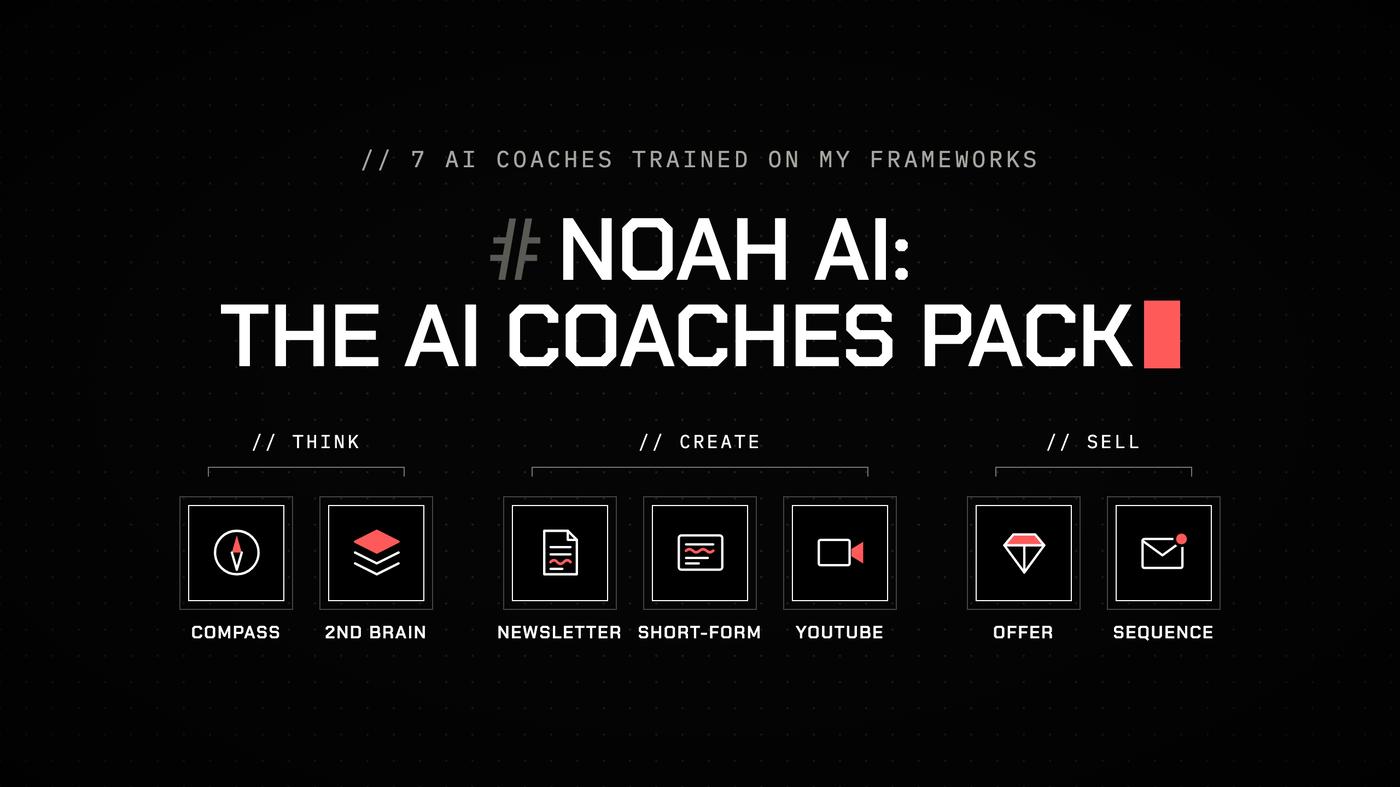
7 AI coaches trained on my frameworks, to think, create and sell

Bring them your positioning, your second brain, your newsletter, your posts, your videos, your offer or your launch emails, and get my feedback, checked against what's working in your market right now.
By Noah7 productsSave 86%12 people have it

These are the 7 AI coaches I built for my 1:1 clients, so they could get my feedback every time they write, build or sell something, and not only during our calls.

Each one is trained on the playbook I use with my clients and in my own business. You bring it your work, and it gives you feedback with my exact method.

They check the market first.

Most of them use Eden to look at what's working in your market right now (the posts, newsletters, videos, positionings and offers that beat their creator's usual numbers) and compare your work with it. So the feedback you get is based on real market data.

The 7 coaches, by what you're working on:

  • Think · Creator Compass: the exact method to turn your scattered interests into a winning positioning for your one-person business. You are the niche.
  • Think · Second Brain Architect: build an AI second brain with Obsidian and Claude Code that runs your life and business.
  • Create · Newsletter Editor: write newsletters people read to the end.
  • Create · Short-Form Editor: write posts that stop the scroll.
  • Create · YouTube Editor: fix your idea, titles, thumbnail and intro before you hit record.
  • Sell · Offer Builder: build a high-ticket coaching offer and the doc that sells it.
  • Sell · Sales Sequence: write the launch emails that sell your offer, in your own voice.

250 AI credits included.

They come on top of Eden's 50 free credits, so you can fully use your coaches even without a paid Eden account. Prefer your own AI agent? Connect your coaches to it with an MCP connection.

Every time I improve a playbook, your coaches get the update too.

What's inside

$679
$97
One-time purchase

You save 86% on buying them one by one

Includes 250 AI credits + a bonus 50 credits

Pay on Stripe's secure page. Your email is shared with Noah.


What's included

  • Noah AI: Creator Compass · Custom AI
  • Noah AI: Second Brain Architect · Custom AI
  • Noah AI: Newsletter Editor · Custom AI
  • Noah AI: Short-Form Editor · Custom AI
  • Noah AI: YouTube Editor · Custom AI
  • Noah AI: Offer Builder · Custom AI
  • Noah AI: Sales Sequence · Custom AI

Sold by Noah

Questions

What do I get?

All 7 AI coaches, each opening in your free Eden account on web and phone, plus 250 AI credits. Every coach comes with its playbook in the Knowledge tab, to read anytime.

Is it a subscription?

No. You pay once and keep the 7 coaches. When I update a playbook, your coaches update too.

How far do 250 credits go?

Each message uses one credit, and the 250 credits come on top of Eden's 50 free ones. They never expire, and you can add more inside Eden if you need them.

Where does the market data come from?

From Eden, which tracks posts and videos across X, Substack, YouTube, LinkedIn, Threads, Instagram and TikTok and compares each one to its creator's usual numbers. The coaches that check the market search it live, so the proof is current. They never make up a post or a number.

Can I use the coaches in Claude or ChatGPT?

Yes. You can chat with them in Eden, or connect them to your favorite AI agent with an MCP connection.

I already own one of the coaches. Should I still get the pack?

The pack price stays the same, and you get the other coaches plus the 250 credits. If you only need one or two more, buying them one by one may cost you less.

Will new coaches be added to the pack?

No. The pack holds these 7. Coaches I build later are sold on their own.

Do I need to be good with AI?

No. Open a coach, paste your work or answer its questions, and talk to it like you'd talk to me.

Get Noah AI: The AI Coaches Pack

$97 one time. Everything is yours the moment you sign up.

Noah

Noah AI: Creator Compass

Custom AI · $97 on its own

The AI version of me finds where your skills and your interests meet, studies how creators on the same topics position themselves, and writes your positioning with you.

  • A guided interview, one question at a time, that finds where your skills and your interests meet.
  • A look at creators on the same topics: their bio, what they're known for and what they sell, and where there's room left for you.
  • A look at your own account (share your handle): which of your topics your audience already responds to.
  • 2 or 3 content verticals and the thread that ties them, with a bridge to the skill you sell.
  • Your one-line positioning, tested on a stranger: what you write about, for whom, and what you help them get.
  • Your fundamentals written with you: values, mission, vision, target and value proposition.
  • Your Creator Compass document, saved in your Eden workspace to keep and share.
  • The Creator Compass Playbook and the Positioning Deep Dive, to read anytime.

Most people think that to make it online, they have to niche down.

So they pick one narrow topic, talk about nothing else, and a year later they're sick of their own business.

That's exactly what happened to me.

I started a Facebook ads agency at 17, then built a coaching business on top of it. Together they reached €14,000 a month. And every single day, my content was about Facebook ads, prospecting and sales calls. I ended up hating it, and I stopped everything.

When I started over and built Noah's Ark, I made one rule: never make that mistake again. My content would be about my expertise, and also about the ideas and the topics I care about most.

This coach helps you build your business the same way.

It finds where your skills and your interests meet.

Your skills make the money. Your interests grow the audience and keep you publishing for years. The coach interviews you on both, one question at a time, and finds the intersection that belongs to you: 2 or 3 content verticals, the thread that ties them together, and a bridge to the skill you sell.

You get to post about what interests you most, and your content still leads to a business that pays.

It studies creators on the same topics.

Before it proposes anything, it looks up creators who already publish on a mix close to yours: their bio, the topics they're known for, who they speak to and what they sell. You see what's taken, what works, and where there's room for you, with ideas for your own line and bio.

Give it your handle and it also reads your account: which of your topics your audience already responds to.

Then it writes your positioning with you:

  • Your one-line positioning: I write about [your interests] for [who], and I help them [the result your skill gives].
  • Your fundamentals: values you can decide with, a mission, a vision with a number and a date, a target described by how they think, and a value proposition.
  • An optional deep dive: competitive scan, strategic pillars, main message and tagline, brand story, brand archetype.

It asks, you answer, it does the synthesis. You confirm every piece before it moves on, and it never invents anything about you.

At the end, it writes your Creator Compass document into your Eden workspace: your whole positioning in one place, ready for your bio, your content plan and your next offer.

It's built on the playbook I use with my coaching clients, and on the work I did to rebuild my own business.

See its full page

Noah AI: Second Brain Architect

Custom AI · $97 on its own

Tell the AI version of me what you use today and what keeps breaking. It diagnoses your setup, designs your vault around what you create and run, writes your CLAUDE.md and SOPs, and stays with you while you build.

  • A diagnosis of your current system: what works, what breaks, and what to fix first.
  • A vault designed around what you create and run: folders, categories, subjects, container notes, properties, templates.
  • A migration plan from Notion, Apple Notes or an old vault, run in batches you approve.
  • A vault audit against the rules that keep a second brain alive, each problem with its fix.
  • Your CLAUDE.md, SOPs and skills written from your real structure, saved as notes you keep.
  • Answers while you build: capture, inbox, notes, content, projects, tasks, reviews and goals.
  • The Second Brain Playbook and its three chapters: every principle the architect uses, to read anytime.

You've probably built a second brain before.

Folders inside folders, a few hundred tags, a whole weekend of setup. Three months later you can't find the idea you need when you sit down to write, and your AI still asks who you are at the start of every session.

This architect helps you build the system I run my own business on, shaped around your life and work, and answers your questions until it runs.

It starts with a brain dump.

Tell it what you use today and what keeps breaking: Notion, Apple Notes, Google Docs, an old Obsidian vault, or nothing at all. It checks your setup against the rules that keep a vault alive and tells you what to fix first.

Then it builds with you:

  • Your vault design: a flat notes folder, categories that file each note the moment you create it, subjects for the topics you think about, container notes for your projects, clients and products, a property schema and the templates to create.
  • Your migration plan: how your old folders, tags and databases map to the new structure, and how your agent moves everything in batches you approve first.
  • A vault audit: paste your folder tree and your CLAUDE.md, and get every problem in order of damage, each with its fix.
  • Your Claude Code layer: a CLAUDE.md written from your real structure, your SOPs, the skills that point to them, and session logs so your agent picks up where it left off.
  • Answers while you build: capture, inbox processing, note-taking, your content pipeline, projects, tasks, reviews and goals.

Every vault plan, CLAUDE.md and SOP it writes lands in your Eden workspace as a note you keep.

It remembers your setup between chats, so you explain your vault once.

You don't need any of my other products. It teaches the full Sovereign Creator OS method and builds from whatever you have today.

It's built on the playbook behind my own vault and my Sovereign Creator OS course.

See its full page

Noah AI: Newsletter Editor

Custom AI · $97 on its own

Send your draft to the AI version of me. It finds the newsletters on your idea that already beat their author's numbers, studies what works on your own account, then gives you the 3 fixes that matter most, in your own voice.

  • A market check on every draft: proven newsletters on the same idea, with how far each one beat its author's usual numbers and which title carried it.
  • A look at your own account (share your handle): what already works for your readers, and whether a new piece plays to it.
  • A full review of any newsletter draft: the verdict, the promise chain, packaging, structure, AI tells and the top 3 fixes.
  • Better titles and subtitles, built only from what your draft actually delivers, at least one on a pattern the market already proved.
  • Focused reviews when you only need help on your title, your subtitle or your intro.
  • My full Anti-AI Writing Guide: every pattern and structure AI overuses, and what to write instead.
  • The Long-Form Newsletter Playbook: every guideline the editor uses, to read anytime.

Most newsletters die in one of two places: nobody clicks, or nobody finishes.

Usually it's a small break in the chain. A title that makes no clear promise, an intro that forgets what the subtitle said, or a body that never delivers the 5 steps the intro announced.

This editor reviews your draft the way I review my coaching clients' newsletters, and it starts where I start: with the market.

It checks the market first.

Before it judges your draft, it searches Eden's index of Substack posts and X articles for pieces that make the same point as yours. It keeps only the ones that beat their author's usual numbers, and reads them in full.

So when it says your idea works, it shows you who already proved it, by how much, and which title and angle carried it. It also tells you when the angle is crowded, and what has to make yours different.

Give it your handle and it also studies your own account: the pieces that already work for your readers, and whether this one plays to them or is a bet.

Then it checks your draft:

  • The promise chain. Does your title, subtitle, first line and intro keep the same promise, and does the body deliver it?
  • Your title, tested on 4 rules (broad, relevant, a clear outcome, low effort), with better options built from what your draft actually delivers, at least one on a title pattern the market already proved.
  • Your structure: old way, new way, how-to, and whether the reader cares before you give the advice.
  • The 4 mistakes that kill a newsletter: the journal entry, too much relating, too much education, and writing a novel.
  • The AI tells. If you use AI to write part of your draft, you also get my full Anti-AI Writing Guide: every pattern and structure AI overuses, and what to write instead, so your piece reads like you wrote it, in your own voice. The editor flags every one it finds in your draft, line by line.

It quotes your actual lines, ranks the top 3 fixes, and ends with one next move.

It won't ghostwrite your newsletter. Your ideas and your voice stay yours.

It's built on the guidelines I use to write my own Ark Letters.

See its full page

Noah AI: Short-Form Editor

Custom AI · $97 on its own

Send your notes to the AI version of me. It compares your idea with the posts on the same idea that already beat their author's numbers, then helps you fix the hook, the structure and the last line so your note can spread and bring you the right people.

  • A market check on every post: proven posts on the same idea from other creators, with how far each one beat its author's usual numbers.
  • A look at your own account (share your handle): what already works for your audience, and whether a new post plays to it.
  • A full review of any post: the verdict, the idea, the hook, the structure, the last line, AI tells and a fixed version.
  • Batch reviews: paste your week of posts and see which to publish first and the one fix each needs.
  • 3 better hooks per post, built only from your own idea, at least one on a pattern the market already proved.
  • New versions of your best posts in other structures, so a winner can run again.
  • My full Anti-AI Writing Guide: every pattern and structure AI overuses, and what to write instead.
  • The Short-Form Playbook: every guideline the editor uses, to read anytime.

One of the best ways to grow an audience is to post short-form content.

But you can't just post notes without thinking about them. To get you known, a note needs an idea that has the potential to spread, in a structure that can go viral, and it has to stay inside your niche. Otherwise it brings you tourists: people who like one post and never read the next.

This editor helps you write those notes. It compares your idea and your note with what already works on the market, then helps you adapt it: a sharper hook, a stronger last line, a cleaner structure.

It checks the market first.

It searches Eden's index of posts on X, Substack, LinkedIn and Threads for posts that make the same point as yours, keeps only the ones that beat their author's usual numbers, and reads them in full. You see who already proved your idea, by how much, and which hook carried it. When nothing proven exists yet, it says that too, and shows you the bigger angle your idea can live inside.

Give it your handle and it also studies your own account: the posts that already work for your audience, and whether this one plays to them or is a bet.

Then it works on your note:

  • Your idea: is it one idea, and do the numbers show people care about it?
  • Your hook, tested on the building blocks of attention (novelty, specific numbers, a callout, stakes, a pattern interrupt...), with 3 better hooks built from your own idea, at least one on a pattern the market already proved.
  • Your structure: it names the one you're using (PAS, BAB, harsh truth, triple tap, story, poem...) and checks you execute it.
  • Your last line, the line people actually remember.
  • The AI tells. If AI helped you write, you get my full Anti-AI Writing Guide, and the editor flags every tell in your note with a fix in your voice.

Send one note for a full review, or this week's batch to know which one to post first. When a note does well, it gives you new versions of the same idea in other structures, so you can post it again.

It works for Substack notes, X posts (long ones too), LinkedIn, Threads, thread hooks and the notes you write to promote an article.

It won't ghostwrite your posts. Your ideas and your voice stay yours.

It's built on the guidelines I use for my own notes.

See its full page

Noah AI: YouTube Editor

Custom AI · $97 on its own

Send your idea or your script to the AI version of me. It compares your angle, your title, your thumbnail and your intro with the videos on the same idea that already beat their channel's numbers, and helps you fix all four before you hit record.

  • A market check on every video: proven videos on the same idea from other creators, with how far each one beat its channel's usual views.
  • A look at your own channel (share your handle): what already works for your audience, and whether a new video plays to it.
  • A packaging review before you write: your angle, 10 titles built from your idea, and 2 thumbnail concepts.
  • A full script review: angle, title, thumbnail, first 30 seconds, structure, examples, ending, AI tells.
  • A post-mortem when a video flops: was it the topic, the packaging, the intro or the middle, and what to test next.
  • My full Anti-AI Writing Guide: every pattern and structure AI overuses, and what to write instead.
  • The YouTube Playbook: every guideline the editor uses, to read anytime.

To make it on YouTube, you need four things to work together:

  1. A unique angle on a topic people already care about.
  2. A title that grabs attention and makes people want to click.
  3. A thumbnail that completes the title, so the two together make the click obvious.
  4. An intro that makes people stay until the end of the video.

These are the four elements that matter most. Get them right, and the rest of your video is just explaining your content and following the steps.

This coach helps you get all four right. It:

  • reviews your script
  • compares your video with what already works on the market
  • compares your angle, your title and your thumbnail with the videos on the same idea that beat their channel's numbers
  • gives you title, angle and thumbnail ideas based on what's working right now
  • improves your intro, your pacing and your structure, so your video has a better shot at going viral

It checks the market first.

It searches Eden's index of YouTube videos for videos on the same idea as yours, keeps only the ones that beat their channel's usual views, and reads them, intro included. You see who already proved your idea, by how much, and which title carried it. When nothing proven exists yet, it says that too, and shows you a stronger angle.

Give it your channel handle and it also studies your channel: the videos that already work for your audience, and whether this one plays to them or is a bet.

Send it what you have: an idea and your title options before you write, your intro when you're not sure it holds people, your full script before you record, or the numbers of a video that flopped to find out what went wrong.

If AI helped you write the script, you also get my full Anti-AI Writing Guide, and the editor flags every AI tell and every line of YouTube filler, with a fix in your voice.

It won't write your script. Your ideas and your voice stay yours.

It's built on the playbook I use for my own videos, including the lessons from the ones that flopped.

See its full page

Noah AI: Offer Builder

Custom AI · $97 on its own

Even if you don't know what to sell yet. The AI version of me brainstorms your offer with you, step by step, then writes the offer doc you send to prospects to sign your first clients.

  • A brainstorm that finds what you can sell, from your skills, your results and your interests.
  • A step-by-step build: the result, 3 pillars, the timeline, what's inside, why you and the price.
  • Pricing with the math: my weekly model, discounted blocks, two sanity checks, and the clients you need for your monthly goal.
  • Your finished offer doc, written into your Eden workspace and ready to send to prospects.
  • The Offer Doc Template: the two doc shapes I use, ready to fill in.
  • A review of an offer doc you already have, with every fix tied to your own words.
  • A fast start from your Creator Compass document, straight to the result.
  • The Offer Playbook: every rule the coach builds against, to read anytime.

The fastest way to reach $5,000 a month as a creator is to sell a high-ticket offer.

At $250 a week, one client pays you about $1,000 a month. Five clients and you're there. A $47 product would need over a hundred sales every month to get you to the same place.

This coach helps you build your own high-ticket offer, even if you don't know where to start, what could be valuable, or what people would pay you for.

First, it brainstorms the offer with you.

One step at a time:

  • What you sell, from the skills you've been paid for, the results you got and your interests. No idea yet? It proposes 2 or 3 offers built from your answers.
  • The result your client can point at when the program ends.
  • Three pillars that get them there.
  • The timeline, week by week, with a milestone for each phase.
  • What's inside: calls, support, reply time, resources. Real numbers only.
  • Why you: your story and your proof. No proof yet? It shows you how to get a first result you can sell.
  • The price: my own model ($250 a week, with discounted 6 and 12-week blocks) as a starting point, and the math for how many clients you need to hit your monthly goal.

It puts a draft in front of you at every step. You pick, change or push back.

Then it writes your offer doc.

Everything lands in one document in your Eden workspace that sums up your whole offer: the promise, the pillars, the timeline, what's inside, why you, the price and how to join. You send it to prospects as a link in a DM or an email, and you sign your first clients with it. You don't need a website or a funnel.

Before you send it, it runs my checklist with you.

Already have an offer? Send your offer doc for a review. Not sure what to charge? Ask it to price your offer.

It never invents your results, your clients or your numbers. When it needs one, it asks.

It's built on the playbook and the offer doc I use for my own 1:1 coaching.

See its full page

Noah AI: Sales Sequence

Custom AI · $97 on its own

The AI version of me interviews you, finds your launch angle, plans and writes every email in your voice, then hands you the whole sequence in one document. Already wrote yours? It tells you what's broken and fixes it.

  • An interview that gets everything a launch needs out of your head, one question at a time.
  • 2 or 3 narrative angle options for your launch, with the one I'd pick and why.
  • A full launch plan: every email's job, send day and action, adapted to your price and dates.
  • Outlines you approve, then full copy for every email in your voice, with subject lines and preview lines.
  • Your sequence saved as a document in your Eden workspace, ready to edit and load.
  • A review mode for emails you already wrote: Strong, Needs work or Broken, then the fixed version.
  • The Sales Email Templates: my skeleton for every type of sales email, from the hook to the final call.
  • My full Anti-AI Writing Guide, to strip the AI tells from any email.
  • The Sales Sequence Playbook: every rule the coach uses, to read anytime.

The best way to sell your products and your coaching is a sales sequence to your email list.

It's how I've made $275K in the creator economy so far. About 90% of my sales come from email.

This coach is trained on the exact sales email structure I use to walk my readers through a launch and make them want to buy. It works for any product or coaching offer.

It writes your sequence with you, step by step:

  1. The interview. One question at a time: your offer, your launch dates, your price and your deadline, the story behind it, your proof, the objections you hear. Then it reads two or three of your past emails, so the copy sounds like you.
  2. The narrative angle. The one belief your whole launch argues. Every email looks at that idea from a different side, so by the last day your reader knows exactly what you stand for.
  3. The plan. Every email with its job, its send day and its one action, adapted to your price and your launch window.
  4. The outlines. Subject lines, opening, beats, proof and P.S. for each email.
  5. Your validation. You approve the angle, the plan and the outlines before it writes a line of copy.
  6. The copy. Every email written in your voice, with subject lines and preview lines, stripped of AI tells before you see it.
  7. Your document. The angle, the plan, the outlines and the emails land in one document in your Eden workspace, ready to load into your email tool.

Already wrote your sequence?

Paste one email or the whole sequence. It tells you what's Strong, what Needs work and what's Broken (subject line, opening, proof, the ask, the deadline, the AI tells), then hands you the fixed version.

It knows every type of sales email.

The hook, the value email, the pitch, the philosophy email, the proof, the Q&A, the case against joining, the last chance and the final call, plus the doors-closed and cart emails. You get my template for each one in your Knowledge tab, and my full Anti-AI Writing Guide.

It never invents anything.

No fake story, no made-up result, no testimonial you didn't get. When an email needs something it doesn't have, it leaves a [placeholder] and asks you for the real thing.

It's built on the playbook I use for my own launches.

See its full page